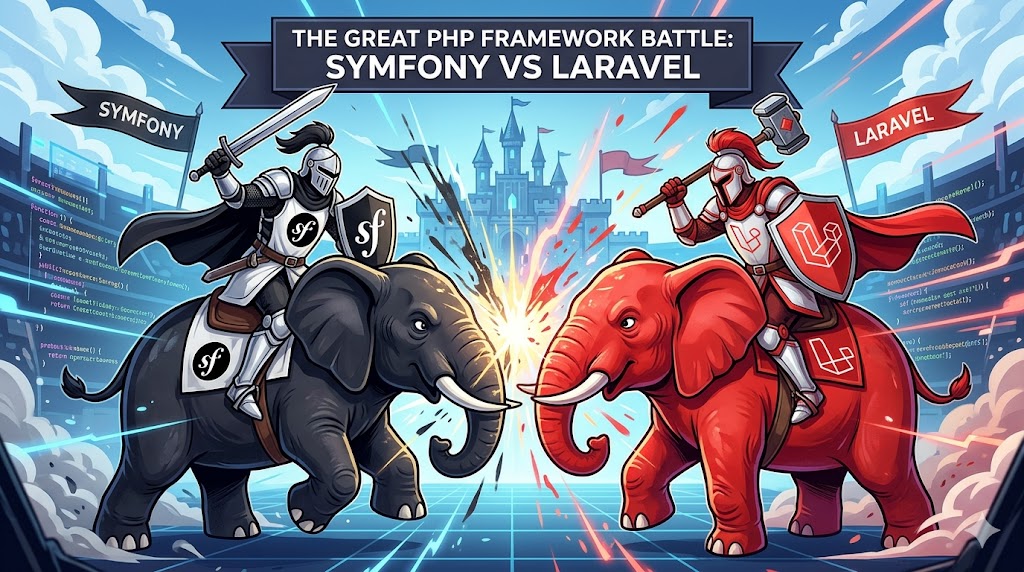
Symfony vs Laravel: Which to Learn in 2026?
The debate between Symfony and Laravel remains vibrant in 2026, each offering compelling philosophies and ecosystems for modern PHP development.
But the both have good proposals in her scope and very important different philosophy.
Laravel – Rapid Development and Rich Ecosystem
- Speed to market: Laravel excels at delivering MVPs and prototypes quickly. Its expressive syntax and powerful CLI (
artisan) enable developers to scaffold applications in minutes. - Comprehensive packages:
- Laravel Cashier – seamless Stripe integration for subscription billing.
- Laravel Sail – Docker‑Compose environment with Redis, MySQL, and more, ready out‑of‑the‑box.
- Laravel Breeze / Jetstream / Inertia – starter kits for Blade, Vue, or React, allowing full‑stack development without leaving the framework.
- Laravel Octane – boosts performance by leveraging RoadRunner or FrankenPHP, reducing cold‑start latency and handling high‑traffic workloads.
- Eloquent ORM – intuitive, chainable query builder that simplifies complex relationships, with built‑in features like soft deletes and timestamps.
- Community and ecosystem – a vast marketplace of packages, tutorials, and conferences makes it easy to find solutions for almost any requirement.
Symfony – Enterprise‑Grade Architecture and Flexibility
- Mature foundation: First released in 2002, Symfony powers many large‑scale applications across Europe, prized for its scalability, resilience, and security.
- Modular components: Use only the bundles you need. Symfony’s component‑based architecture lets you build minimalistic applications or full‑featured systems.
- Robust configuration: Supports annotations, YAML, and PHP configuration, giving developers fine‑grained control over routing, services, and dependency injection.
- Doctrine ORM – a powerful, feature‑rich ORM that rivals Eloquent, offering advanced mapping, caching, and migrations.
- Performance: Optimized for micro‑service architectures; combined with Messenger, Redis, and event‑driven patterns, Symfony can handle high‑traffic, complex back‑ends.
Choosing the Right Tool
- Quick prototypes or startups – Laravel’s batteries‑included approach lets you launch a polished web app within a week.
- Large, complex, or high‑traffic systems – Symfony’s flexibility and enterprise‑grade components make it ideal for micro‑services, APIs, and applications demanding strict performance and security guarantees.
- Team expertise – Consider the existing skill set; Laravel’s learning curve is gentler, while Symfony may require deeper knowledge of design patterns and configuration.
In 2026, the decision is less about “which framework is superior” and more about aligning the framework’s strengths with your project’s goals, team experience, and long‑term maintenance strategy. Both Laravel and Symfony continue to evolve, and mastering either will equip you with valuable skills for the modern PHP ecosystem.
You can create simply application and website or heavy applications with both.